Every Catholic church regardless of its size or location should be a place of beauty, reverence, and vibrant spirituality. This doesn’t mean that every church must be excessive in its cost or its furnishings. But it does mean that everything that is done should be of good quality and in excellent taste. Who decides what a church should look like and how it should be furnished? What are the standards that should determine which sacred objects and images are appropriate for a holy place dedicated to giving thanks and praise to God?
St. Paul Catholic Church in Tell City, Indiana, recently renovated the interior of its church building. The decision-making process, and the artistic principles used to guide this renovation, were the subject of the Dolle Lecture at Saint Meinrad Seminary and School of Theology on September 11, 2025, titled, “Renewing Sacred Art and Synodality at St. Paul Catholic Church” given by Father Tony Hollowell and artist Nick Ring.
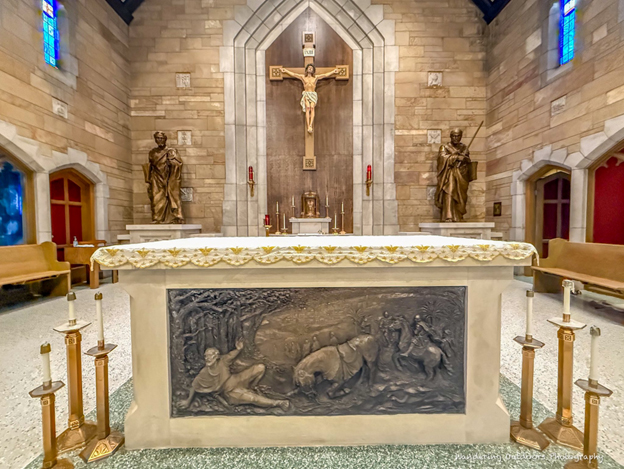
The lecture focused on the collaborative decision-making process used in renovating the interior of the church as well as the artistic principles undergirding these decisions. Special emphasis was given to the renovated altar because it was the primary object to be renovated.
Father Tony Hollowell is the pastor at St. Paul and St. Mark Catholic Churches in Tell City. He is also dean of the Tell City Deanery, and associate vocations director for the Archdiocese of Indianapolis.
Nick Ring is an award-winning artist whose diverse body of work spans sculpture, painting, drawing and furniture design. Since 1991, he has created significant works for public, institutional, private and sacred spaces. Notably, his liturgical art includes the holy water font and ambo for the Archabbey Church at St. Meinrad and the new altar at St. Paul’s in Tell City.
Deeply rooted in the western classical tradition, Ring’s work reflects a profound commitment to craftsmanship, symbolism, and spiritual resonance. His dedication to quality and authenticity distinguishes him as an artist who can create sculpture and other sacred images that are especially appropriate for places of worship.
To plan for the interior renovation of St. Paul’s Church, Father Hollowell and his team considered how the theme of synodality should be applied to this renovation. Instead of thinking of the project as a series of permissions and arguments, what actually happened was a series of “holy conversations” between the archbishop’s representatives, the pastor and other priests and deacons, and the people of the parish. Without important voices from the people of God, this renovation would have never occurred.
According to Father Hollowell:
In its essence, this renovation was a three-year conversation between the diocese, the artist and architects, and our parish community about the history of sacred art, the place of Saint Paul’s within that history, and how to develop this history further by a renovation which preserved both “the old and the new” (Matthew 13:52). I wanted our parish to move beyond the idea of Tradition as static and referring only to the past; instead, it should refer to something living, present, and alive. All Tradition (including the parish’s tradition of Sacred Art and Architecture) should not look only to the past but also to the present. Ironically, by appealing to this living dimension of tradition, our synodal process yielded a final design that many parishioners have labeled a “more traditional” look.
Father Hollowell believes that Nick Ring’s concept of tradition as something which is alive was indispensable in providing a successful blend of new and old. Because of Ring’s understanding of both St. Paul’s church, and of sacred art as a whole, a final design was created that is fully contemporary and yet fully classical.
Ring’s rendering of the conversion of Saint Paul at the base of the altar contains many elements that are “new.” It is the first piece of bronze art to be included in the church, and it is a unique rendering of St. Paul’s conversion. Other elements are “old.” The altar is made of limestone, which retains a long tradition of having a limestone altar in this specific church, and the emphasis on Paul’s horse continues a tradition of artistic reflection on this part of his conversion.
We are all called to be good stewards of the Church’s living tradition of sacred art and architecture. Using synodal decision-making and proven principles of artistic design, we are invited to build and sustain holy places for God.
Daniel Conway